
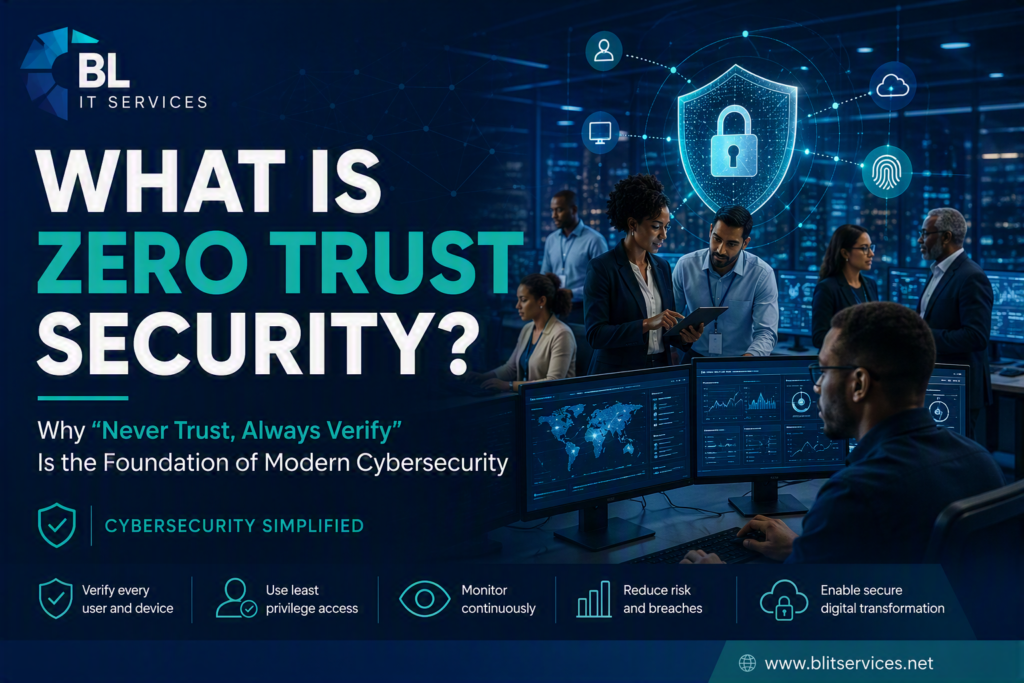
Cybersecurity is no longer just an IT concern. It is a business imperative.
As organisations embrace cloud computing, remote work, artificial intelligence, and digital transformation, traditional security models are struggling to keep up with modern cyber threats. The assumption that users and devices within a corporate network can be trusted is no longer valid.
This is where Zero Trust Security comes in.
Zero Trust has become one of the most important cybersecurity strategies for organisations seeking to protect their data, systems, and users in an increasingly connected world.
What Is Zero Trust Security?
Zero Trust is a cybersecurity framework based on a simple principle:
Never Trust. Always Verify.
Unlike traditional security approaches that trust users and devices once they are inside the network perimeter, Zero Trust assumes that every access request could be malicious, regardless of where it originates.
Every user, device, application, and connection must be continuously authenticated, authorised, and validated before access is granted.
In simple terms, Zero Trust treats every access request as if it comes from an untrusted source.
Why Traditional Security Models Are No Longer Enough
For many years, organisations relied on a “castle and moat” approach to security.
The network perimeter acted as a protective wall, and anything inside the network was generally trusted.
However, today’s workplace looks very different:
- Employees work from multiple locations
- Applications are hosted in the cloud
- Users access systems from personal and corporate devices
- Third-party vendors require access to business resources
- Cybercriminals use increasingly sophisticated attack techniques
As a result, the traditional network perimeter has effectively disappeared.
Once attackers gain access to a compromised account, they can often move laterally through systems, access sensitive information, and disrupt operations.
Zero Trust helps prevent this by eliminating implicit trust.
The Three Core Principles of Zero Trust
1. Verify Explicitly
Every access request should be authenticated and authorised based on multiple factors, including:
- User identity
- Device health and compliance
- Location
- Risk level
- Data sensitivity
This often involves technologies such as Multi-Factor Authentication (MFA), Conditional Access, and identity protection solutions.
2. Use Least Privilege Access
Users should only receive the minimum level of access required to perform their duties.
By limiting permissions, organisations can reduce the impact of compromised accounts and insider threats.
If an attacker gains access to a user account, the damage they can cause is significantly reduced.
3. Assume Breach
Zero Trust operates on the assumption that a security breach could occur at any time.
Instead of focusing only on prevention, organisations continuously monitor activity, detect suspicious behaviour, and respond quickly to threats.
Continuous monitoring helps identify risks before they escalate into major incidents.
What Are the Benefits of Zero Trust?
Improved Security
Zero Trust significantly reduces the likelihood of unauthorised access by requiring continuous verification of users and devices.
Reduced Risk of Data Breaches
Even if attackers compromise a user account, additional security controls limit their ability to move through systems and access sensitive information.
Better Visibility
Organisations gain greater visibility into user activity, device health, and access patterns, enabling more informed security decisions.
Enhanced Compliance
Many regulatory and governance frameworks require strong identity management, access controls, and security monitoring. Zero Trust supports these requirements.
Secure Remote and Hybrid Work
Employees can work securely from any location without compromising organisational security.
How Microsoft Enables Zero Trust
Microsoft provides a comprehensive portfolio of solutions designed to support a Zero Trust strategy, including:
- Microsoft Entra ID
- Microsoft Defender
- Microsoft Sentinel
- Microsoft Intune
- Microsoft Security Copilot
- Microsoft Purview
Together, these technologies help organisations verify identities, secure devices, protect data, detect threats, and respond rapidly to security incidents.
Is Zero Trust Only for Large Organisations?
Not at all.
Whether you’re a municipality, educational institution, healthcare provider, small business, or enterprise organisation, Zero Trust principles can help improve your overall security posture.
Cybercriminals often target organisations of all sizes, making it essential to adopt a proactive approach to cybersecurity.
The good news is that Zero Trust is a journey rather than a single project. Organisations can implement it gradually, starting with foundational controls such as Multi-Factor Authentication and identity protection.
Taking the First Step
Many organisations already have some of the tools required to implement Zero Trust but are not using them to their full potential.
A security assessment can help identify gaps, prioritise improvements, and create a practical roadmap for implementation.
By adopting Zero Trust principles, organisations can strengthen cyber resilience, protect critical assets, and enable secure digital transformation.
Final Thoughts
Cyber threats will continue to evolve, but the principle behind Zero Trust remains simple:
Never trust by default. Always verify before granting access.
Organisations that embrace this modern approach to security are better positioned to protect their people, data, and operations while enabling innovation and growth.
As digital transformation accelerates, Zero Trust is no longer a future consideration. It is a business necessity.
Learn More About Our Cybersecurity Services
A successful Zero Trust journey starts with understanding your current security posture and identifying opportunities for improvement.
BL IT Services helps organisations assess, design, and implement modern security solutions that reduce risk and strengthen cyber resilience.
👉 Explore our Cyber Security Services https://www.blitservices.net/services/
👉 Contact BL IT Services https://www.blitservices.net/contact-us/
Need Help Improving Your Security Posture?
BL IT Services helps organisations:
✅ Conduct Security Assessments
✅ Implement Zero Trust Strategies
✅ Deploy Microsoft Security Solutions
✅ Strengthen Identity and Access Management
✅ Implement Microsoft Sentinel and Security Operations Capabilities
✅ Accelerate AI and Security Copilot Readiness
📧 info@blitservices.net
🌐 www.blitservices.net
📞 +27 (0) 12 006 0047